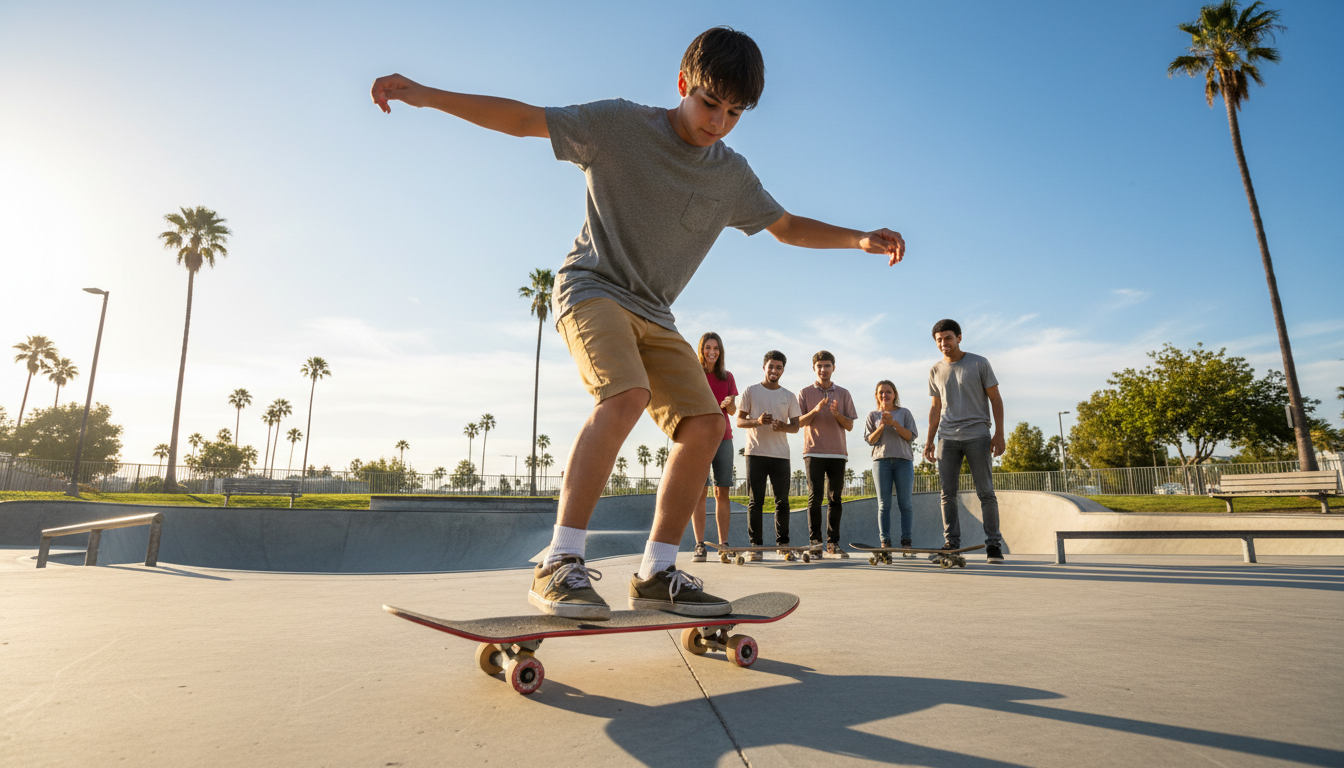
Mastering skateboard tricks requires a solid foundation in the basics. Before attempting any tricks, it’s essential to be comfortable with pushing and stopping on your board.
Learning to balance on the board is crucial, as it forms the basis for all skateboarding skills. By starting with the fundamentals and progressing gradually, beginners can build confidence and develop essential muscle memory.
A well-structured progression guide helps learners move from basic balance to more complex techniques like ollies. This progression ensures that beginners develop proper technique from the start, avoiding bad habits that could hinder future progress.
Getting Started: Mastering the Fundamentals
Before attempting complex tricks, it’s essential to grasp the foundational skills of skateboarding. Mastering these basics will provide a solid foundation for more advanced techniques.
Finding Your Stance and Balance
Finding your stance on a skateboard is the first step towards balance and stability. Experiment with different foot positions to determine whether you’re regular or goofy footed. Your dominant foot should be at the back of the board, with your other foot at the front. Balancing on the board requires keeping your knees bent and your weight centered over the skateboard.
Basic Pushing Techniques
Pushing is a fundamental skill that propels you forward on the skateboard. To push, place your front foot on the board and push off the ground with your back foot. As you gain momentum, bring your back foot onto the board, positioning it near the tail. The way you distribute your weight on the board affects your balance and ability to maneuver.
Stopping Methods for Beginners
Stopping is a critical skill for skateboarders. There are several methods to stop on a skateboard. The simplest way is to drag your back foot on the ground, creating friction to slow down. Alternatively, you can use the tail drag technique by pressing down on the tail to lift the front wheels and drag it on the ground. For lower speeds, stepping off the board and pushing backward is another effective method.
| Stopping Method | Description | Speed Suitability |
|---|---|---|
| Foot Drag | Drag your back foot on the ground to create friction. | All speeds |
| Tail Drag | Press down on the tail to lift the front wheels and drag it on the ground. | Moderate to high speeds |
| Reverse Push | Step off the board and push backward to slow down. | Low speeds (under 10 mph) |
Essential Equipment for Learning Tricks
Skateboarding is not just about riding; it’s about mastering tricks, and the right equipment can make all the difference. As beginners start their skateboarding journey, understanding the essential gear can significantly impact their learning curve and overall experience.
Choosing the Right Skateboard Setup
For beginners, selecting the right skateboard is crucial. A good starter skateboard should have a width between 7.5 and 8 inches, making it easier to balance. The wheel hardness should be around 95A, providing a smooth ride on various surfaces. When it comes to the skateboard deck, a concave shape is recommended as it allows for better foot positioning.
Safety Gear Recommendations
Safety gear is paramount for beginners learning skateboard tricks. A helmet is the most critical piece of safety equipment, capable of preventing serious head injuries. Knee pads, elbow pads, and wrist guards are also essential, protecting different parts of the body during falls. When choosing safety gear, look for features like hard plastic caps on knee pads and proper helmet certification.
Professional skaters also prioritize safety, showing that protective gear is not just for beginners. For instance, during street skating, wrist guards can be particularly useful, while knee pads are crucial for transition skating.
By investing in the right skateboard and safety gear, beginners can significantly enhance their learning experience, making the process smoother and more enjoyable. Over time, as skaters progress, they can adjust their equipment to suit their evolving needs and preferences.
Pre-Ollie Beginner Skateboard Tricks
The journey to advanced skateboarding starts with simple, foundational tricks that build balance, coordination, and confidence. Mastering these beginner skateboard tricks is crucial before moving on to more complex maneuvers like ollies.
The Caveman: Your First Trick
The “Caveman” is a great starting point for beginners. It involves picking up the skateboard with your back foot and stepping on it with your front foot, mimicking a primitive or “caveman-like” action. This trick helps skateboarders get comfortable with the board’s movement and their stance.
Riding Switch: Building Versatility
Riding switch means skateboarding with your non-dominant foot forward. This trick improves overall skateboarding versatility and balance. To ride switch, start by standing on the board with your non-dominant foot on the tail and your dominant foot on the nose.
Kick Turns: Changing Direction
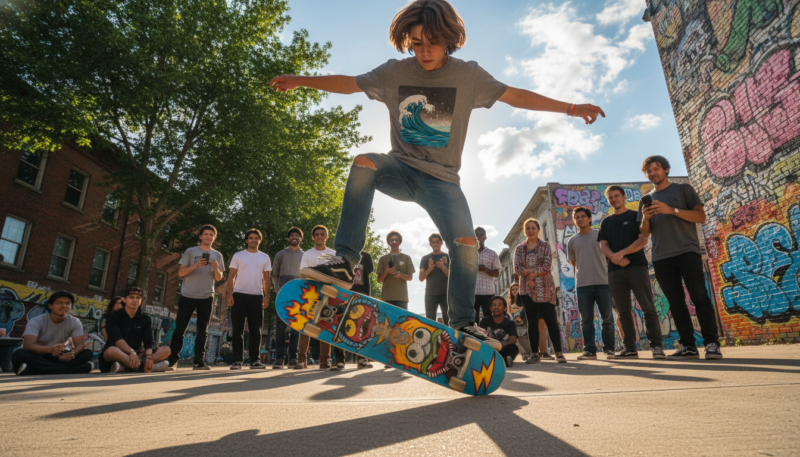
Kick turns are fundamental for changing direction on a skateboard. To perform a kick turn, shift your weight onto your back foot, and with your front foot, kick the ground to turn the board.
Tic Tacs: Gaining Momentum
A tic tac is a simple yet effective trick for gaining momentum without pushing. It involves performing quick kick turns back and forth, from frontside to backside and vice versa. The quicker you perform tic tacs, the faster you’ll go.
Mastering these pre-ollie tricks lays the groundwork for more advanced skateboarding techniques. By practicing these foundational tricks, skateboarders can improve their balance, control, and overall skateboarding skills.
Mastering the Manual
Learning to manual is an essential milestone for skateboarders looking to improve their balance and control. A manual involves balancing on the back wheels while rolling, without letting the tail touch the ground. This skill not only looks stylish but also enhances a skateboarder’s overall ability to manipulate the board.
Proper Foot Placement for Manuals
To initiate a manual, proper foot placement is crucial. Your back foot should be positioned near the tail, with your front foot placed towards the middle of the board. The exact positioning may vary depending on your comfort and the board’s size. For more detailed guidance, you can refer to the ultimate manual guide.
Weight Distribution Techniques
Weight distribution is key to maintaining a manual. Shift your weight back over the rear wheels by leaning back slightly, but avoid putting too much pressure on the tail. Keep your knees bent to lower your center of gravity and improve balance. The goal is to find a balance point where you can sustain the manual without the tail touching the ground.
Common Manual Mistakes to Avoid
Beginners often make a few common mistakes when learning to manual. One of the most frequent errors is letting the tail scrape against the ground, which isn’t a true manual. To correct this, focus on proper weight distribution. Another mistake is leaning too far back, causing the manual to become uncontrolled. Keeping your upper body relaxed and your knees bent can help mitigate this issue. Additionally, avoid looking down at the board, as this can throw off your balance; instead, keep your vision forward while being aware of the board’s position.
Lastly, attempting manuals at the wrong speed can hinder progress. Start at a moderate speed and adjust as you become more comfortable with the trick. With practice, you’ll be able to manual with ease, enhancing your skateboarding skills.
Stalls and Simple Tricks for Obstacles
As skaters progress in their journey, they often encounter various obstacles that require specific techniques to navigate smoothly. Mastering stalls and simple tricks is essential for enhancing their skills and confidence on different terrains.
Nose Stalls on Curbs
Nose stalls on curbs are a fundamental trick that involves balancing the skateboard’s nose on the curb while keeping the tail suspended in the air. To execute this trick, skaters must position their foot correctly on the board and apply gentle pressure to balance on the curb. Practicing nose stalls helps improve balance and control.
A table summarizing key points for nose stalls on curbs:
| Technique | Foot Placement | Balance Point |
|---|---|---|
| Nose Stall | Front foot near the bolts | Nose on the curb |
| Balance Adjustment | Back foot on the tail | Adjust weight for balance |
Rock to Fakie on Ramps
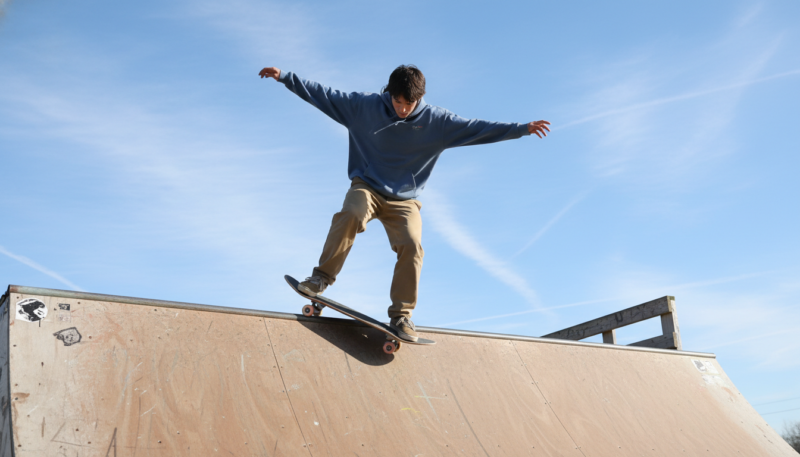
Rock to fakie is a trick performed on ramps where the skater rolls up the ramp, rocks the board on the coping, and then rolls backward without dropping in. This trick requires precise foot placement and the ability to control the board‘s movement. It’s an excellent way to practice transitioning on ramps.
Pop Up and Running Start Techniques
The pop-up technique involves popping the tail of the skateboard with one foot while the other foot is on the ground, catching the board in mid-air. This trick adds style to a skater’s repertoire and is useful for approaching obstacles. A running start, or “throw down,” involves holding the board, running, and then jumping onto it smoothly. Both techniques require practice to master the timing and foot pressure.
By mastering these techniques, skaters can enhance their overall performance and style, making their skateboarding more efficient and enjoyable.
The Ollie: Foundation of Advanced Skateboarding
Mastering the ollie is a crucial step in advancing your skateboarding skills. The ollie is a fundamental technique that allows skaters to jump and maneuver their board in the air, setting the stage for more complex tricks.
Foot Position for Perfect Ollies
Proper foot positioning is critical for executing a successful ollie. Your back foot should be placed on the tail of the board, with your front foot positioned near the middle of the board. The back foot is used to snap the tail against the ground, generating the pop that lifts the board into the air. Meanwhile, the front foot guides the board and helps in leveling it out during the jump.
The Pop, Slide, and Jump Mechanics
The mechanics of an ollie involve three key actions: the pop, the slide, and the jump. The pop is initiated by snapping the tail of the board against the ground with your back foot. As the board pops into the air, your front foot slides forward towards the nose, helping to level the board. Finally, you jump, lifting your feet off the ground and allowing the board to rise with you. Timing is crucial; the pop, slide, and jump must be executed in quick succession to achieve a smooth ollie.
Troubleshooting Your Ollie Technique
Beginners often encounter several common issues when learning to ollie. One problem is the board rotating frontside or backside in the air, usually due to uneven foot pressure or shoulder alignment issues. To correct this, focus on applying even pressure with both feet and keeping your shoulders aligned with the board.
Another issue is the board shooting out in front of the skater, typically resulting from leaning too far back during the pop. To fix this, try to keep your weight centered over the board and think about jumping forward, in the direction of the nose, when popping off the ground.
Additionally, achieving sufficient height can be a challenge. This might be due to insufficient pop, poor slide technique, or inadequate jump height. Filming your ollies in slow motion can help identify the exact issue, allowing you to make targeted adjustments.
By understanding and addressing these common problems, skaters can improve their ollie technique, laying the groundwork for more advanced skateboarding maneuvers.
Building on the Ollie: First Variations
Once you’ve got the ollie down, it’s time to start experimenting with variations that will take your skateboarding to the next level. Mastering the ollie is a significant achievement, but it’s just the beginning. By learning new tricks and variations, you can continue to challenge yourself and improve your skills.
Frontside 180: Your First Rotation
The Frontside 180 is a natural progression from the ollie, introducing rotation to your jump. To perform a Frontside 180, you’ll need to modify your ollie technique by twisting your body and board 180 degrees while airborne. Start by practicing the motion on the ground before attempting it in the air. Focus on snapping the tail and sliding your front foot to initiate the spin.
- Practice the spinning motion on the ground to get comfortable with the movement.
- Focus on your foot placement and body positioning to control the spin.
- Start with small rotations and gradually increase the angle as you become more confident.
Shove It: Board Rotation Basics
A Shove It is another fundamental trick that builds on the ollie. It involves making the board spin with your foot without leaving the ground. To perform a Shove It, you’ll need to pop the board and use your back foot to scoop it, making it spin. Timing is crucial, as you need to catch the board with your trucks facing the right direction.
For more detailed instructions on mastering the ollie, which is foundational for these tricks, visit this guide to improve your technique.
Ollie North: Adding Style
The Ollie North, also known as a “one-foot ollie,” adds a stylish twist to the traditional ollie. To perform an Ollie North, you pop the ollie as usual, but instead of leveling the board with your front foot, you slide it up and kick off the board before bringing your front foot back to land. Timing is everything; you need to kick off quickly to avoid sticking to the board and to return your foot in time to land smoothly.
- Practice your ollie to ensure you have the basic motion down.
- Focus on the timing of kicking off with your front foot and returning it to the board.
- Experiment with different kick directions to add personal style to your Ollie North.
Progression to Flip Tricks
As skaters progress in their journey, they often find themselves at the threshold of mastering flip tricks. Flip tricks are an essential part of skateboarding, offering a new level of complexity and style to one’s skating.
Kickflip Preparation
To master the kickflip, it’s crucial to start with the right foot positioning. Place your front foot near the front bolts with your toes slightly hanging off the edge. Your back foot should be centered on the tail, ready to pop the board into the air. The flicking motion for a kickflip involves using the side of your front foot to flip the board. Practice this motion by holding the board stationary and flicking it with your foot.
- Position your front foot correctly near the front bolts.
- Use the side of your front foot to flick the board.
- Practice the flicking motion while holding the board.
Building Blocks for Heelflips
The heelflip is a complementary trick to the kickflip, requiring a different flicking motion. To set up for a heelflip, place your front foot near the bolts with your toes hanging off the side, and your back foot on the tail. When you pop the board, slide your front foot forward and out, flicking off the corner of the nose with your heel. Stay over the board as it flips and stomp down onto the bolts when it’s ready.
- Position your front foot near the front bolts with toes hanging off.
- Flick the board with your heel off the nose.
- Keep your weight centered over the board as it flips.
Conclusion: Continuing Your Skateboarding Journey
Now that you’ve learned these 15 beginner skate tricks, the real fun begins. You’ve built a solid foundation, and it’s time to put your new skills into practice. Skateboarding is a lifelong journey, with progress happening in bursts rather than linearly.
To continue improving, film yourself to identify technique issues, skate with more experienced skaters, and challenge yourself with new obstacles. Braille Skate wants to see your progress! Share a clip of your favorite trick on Instagram, tagging @brailleskate and using #brailleskateboarding.
FAQ
What is the best way to position my feet on a skateboard?
For most skaters, placing the front foot near the nose and the back foot on the tail provides optimal balance and control. Experimenting with different foot positions can help determine the most comfortable stance.
How do I maintain balance while riding a skateboard?
To maintain balance, keep your weight centered over the board, with your knees bent to lower your center of gravity. Practice shifting your weight to adjust to different terrain and movements.
What is the proper technique for performing an ollie?
To perform an ollie, snap the tail downward to pop the board into the air, while sliding your front foot upward to level the board. Timing and coordination are crucial for a successful ollie.
How can I improve my manual skills on a skateboard?
To improve manual skills, practice balancing on the rear or front wheels, shifting your weight to maintain control. Start on flat ground and gradually move to more challenging terrain.
What safety gear is recommended for skateboarding?
Essential safety gear includes a helmet, knee pads, and elbow pads. Wearing protective gear can significantly reduce the risk of injury while skateboarding.
How do I ride switch on a skateboard?
Riding switch involves reversing your normal stance, so your opposite foot is forward. Practice riding switch to improve overall balance and versatility.
What is the difference between a kickflip and a heelflip?
A kickflip involves flipping the board with your toes, while a heelflip involves flipping the board with your heel. Mastering both tricks requires practice and patience.
How can I troubleshoot issues with my ollie technique?
To troubleshoot ollie issues, analyze your foot position, pop, and slide. Make adjustments as needed to improve timing and coordination.
