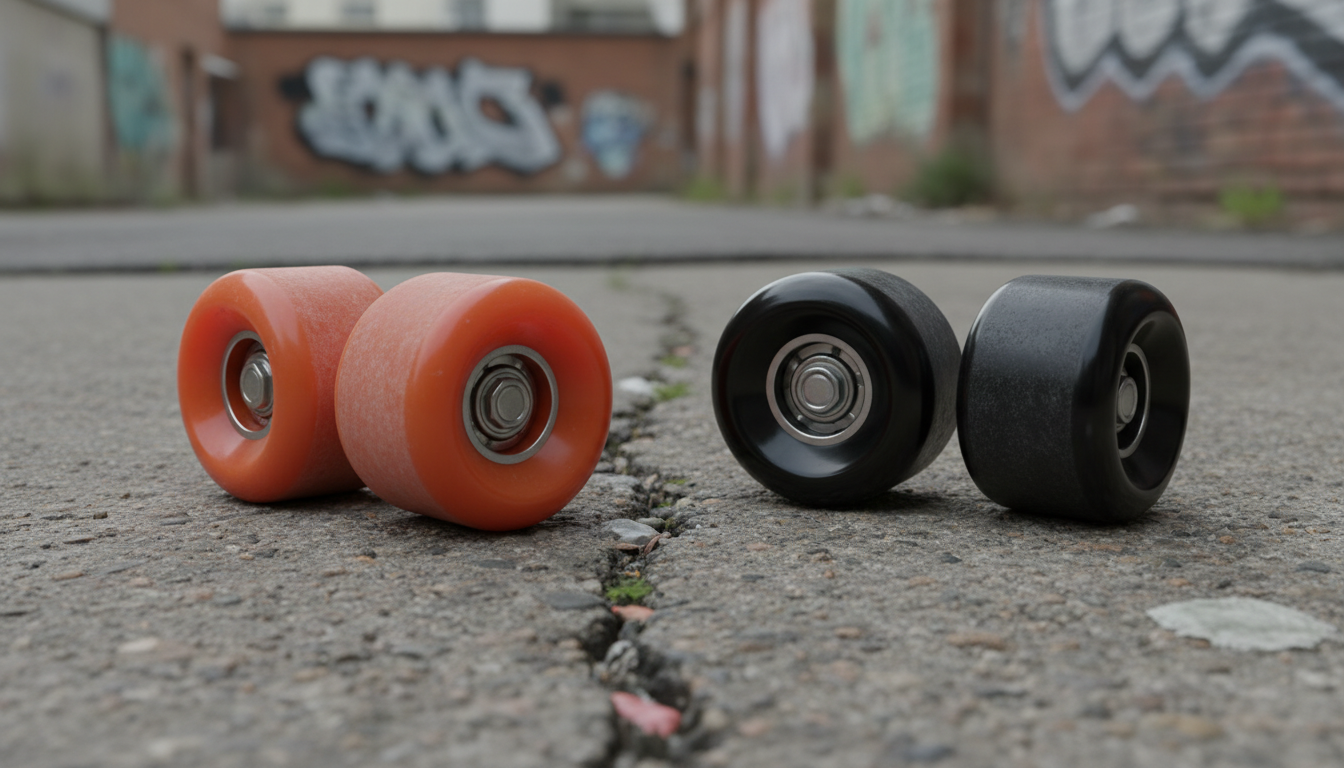
Navigating rough city pavement on a skateboard can be challenging, and the right skateboard wheels can make all the difference. The wrong wheels can significantly impact your riding experience, stability, and trick performance.
Urban skaters need to consider the fundamental differences between soft and hard wheels to make informed decisions based on their specific riding environments. Wheel hardness affects ride quality on various city surfaces, from smooth skate parks to cracked sidewalks and rough asphalt.
Understanding the science behind wheel construction and materials provides valuable insight into why certain wheels perform better than others in urban environments, helping skaters choose the best option for their street skating needs.
Understanding Skateboard Wheels for City Riding
For city skaters, the right skateboard wheels can make all the difference between a smooth ride and a frustrating experience. Urban environments present a myriad of challenges, from rough asphalt and cracked sidewalks to unexpected obstacles like pebbles and expansion joints. The key to navigating these diverse conditions lies in understanding how different skateboard wheels perform on various surfaces.
The Challenge of Urban Skating
Urban skating is characterized by its unpredictability. Skaters must adapt to changing surface types, from smooth concrete to rough asphalt, all while maintaining the ability to perform technical tricks and maneuvers. The constant transition between different surfaces means that skateboarders need to carefully consider their wheel selection to ensure consistent performance throughout their sessions. For more detailed guidance on choosing the right wheels, skaters can refer to resources like the Skateboard Wheels Buying Guide.
Why Wheel Selection Matters for City Pavement
Wheel selection directly impacts several critical factors when skating on city pavement: speed, stability, grip, and shock absorption. The right skateboard wheels can significantly reduce fatigue by absorbing vibrations from rough surfaces, allowing for longer, more enjoyable skating sessions. Understanding how different wheel characteristics affect performance on various surfaces helps skaters make informed decisions about the best setup for their specific urban environment.
| Wheel Characteristic | Impact on City Riding |
|---|---|
| Wheel Hardness | Affects grip and durability on rough surfaces |
| Wheel Size | Influences speed and maneuverability |
| Contact Patch | Impacts stability and grip on various surfaces |
By considering these factors and choosing the appropriate skateboard wheels, urban skaters can enhance their overall skating experience, making it more enjoyable and less frustrating.
The Science Behind Skateboard Wheels
Understanding the science behind skateboard wheels is crucial for selecting the right wheels for city riding. The performance of skateboard wheels is influenced by their material composition and construction. Modern skateboard wheels are primarily made from polyurethane, a versatile plastic material.
Wheel Materials and Construction
Modern skateboard wheels are made from polyurethane (commonly referred to as urethane), which replaced clay wheels in the 1970s. Different manufacturers use proprietary urethane formulations that significantly impact wheel performance characteristics, including durability, rebound, and resistance to flat spots.
The molecular structure of the urethane used in skateboard wheels determines how the material responds to pressure, impact, and abrasion. Wheel construction typically falls into two categories: standard wheels (solid urethane) and core wheels (featuring a rigid plastic core surrounded by urethane).
How Wheels Impact Your Ride
The density and consistency of the urethane directly affect how wheels perform on different surfaces. Softer compounds absorb more shock but wear faster, while harder compounds last longer but transmit more vibration to the rider.
Manufacturing processes like heat treatment and curing time influence the final characteristics of skateboard wheels. Premium brands invest heavily in proprietary technologies to enhance performance, particularly for riding on rough city pavement.
Wheel Hardness Explained: The Durometer Scale
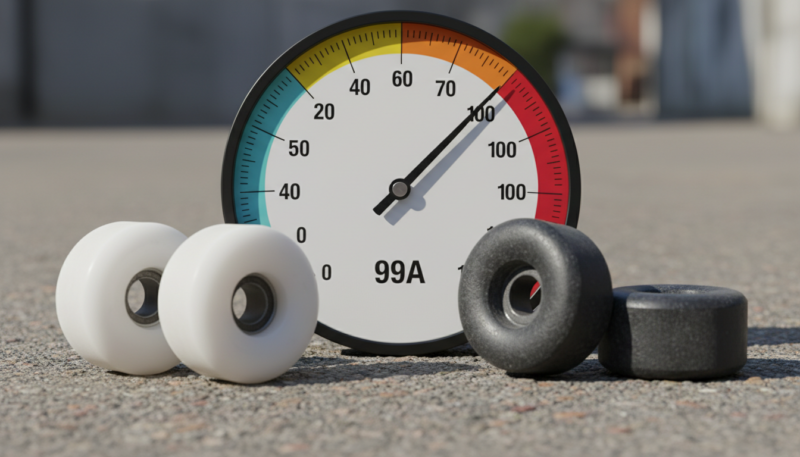
Understanding wheel hardness begins with the durometer scale, a crucial measurement system for skateboard wheels. The durometer scale measures the hardness of skateboard wheels, which directly impacts their performance on various surfaces.
Understanding the A Scale
The “A” scale is the most commonly used reference point for measuring skateboard wheel hardness, ranging from 78A (very soft) to 101A (very hard). Softer wheels, typically between 78A and 87A, absorb more shock and provide better grip on rough surfaces. In contrast, harder wheels, ranging from 95A to 101A, offer less grip but provide greater speed and slide capability.
- Soft wheels (78A-87A) are ideal for rough terrain as they absorb shock and provide better grip.
- Medium-hard wheels (88A-95A) offer a balance between grip and speed, making them suitable for mixed surfaces.
- Hard wheels (95A-101A) are better for smooth surfaces where speed is crucial.
The B Scale for Extra Hard Wheels
For extremely hard wheels, some manufacturers like Bones use the “B” scale, which reads approximately 20 points lower than the equivalent A scale measurement. For instance, an 83B wheel is equivalent to a 103A wheel. The B scale was developed to provide more precise measurements for very hard wheels, as the A scale becomes less accurate above 100A.
Understanding the durometer scale and its various measurements helps skaters make informed decisions about which wheel hardness will best suit their riding environment and style, particularly in urban settings with varied surfaces.
Soft Skateboard Wheels: Advantages for Rough Terrain
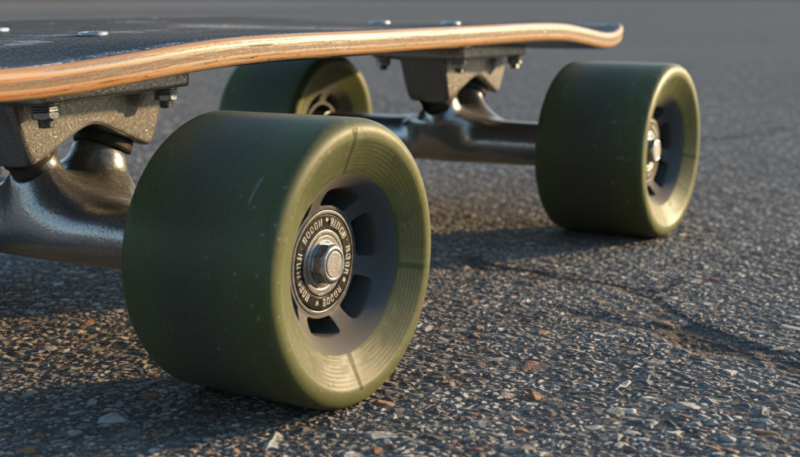
Soft skateboard wheels are designed to handle rough surfaces, offering a smoother ride for skaters. These wheels are particularly beneficial for those who frequently ride on uneven or rough city streets.
Soft Wheel Characteristics
Soft skateboard wheels, typically ranging from 78a to 92a on the durometer scale, offer superior shock absorption capabilities. This makes them ideal for navigating the imperfect surfaces commonly found in urban environments. The softer material compresses slightly when encountering obstacles like cracks, pebbles, and rough patches, effectively absorbing vibrations that would otherwise transfer to the rider’s feet and legs.
The increased grip provided by soft wheels offers better traction on slippery or uneven surfaces, giving riders more confidence when pushing through areas with varying terrain quality. Soft wheels roll more smoothly over rough surfaces because they conform slightly to irregularities rather than bouncing over them, maintaining momentum better than harder wheels when traversing uneven ground.
Performance Benefits on Rough Surfaces
The noise reduction properties of soft wheels make them significantly quieter than harder options, an advantage for urban skaters concerned about noise restrictions in certain areas or those who simply prefer a less disruptive skating experience. While soft wheels excel on rough terrain, they do have drawbacks, including increased rolling resistance, which can make them feel slower, and greater susceptibility to flat spots when sliding.
Many street skaters who primarily ride in areas with poor pavement quality choose slightly softer wheels (around 87a-92a) as a compromise that still allows for technical tricks while providing enough cushioning for rough surfaces. This balance makes soft skateboard wheels an attractive option for skaters who need to navigate a variety of terrain conditions.
Hard Skateboard Wheels: When to Choose Them

Hard skateboard wheels offer superior performance for experienced skaters, especially on smooth surfaces. These wheels are designed to provide maximum speed and responsiveness, making them ideal for technical street skating and skate parks.
Characteristics of Hard Wheels
Hard skateboard wheels, typically ranging from 95a to 101a on the durometer scale, are known for their durability and ability to maintain speed. They excel on smooth surfaces like skate parks, polished concrete, and well-maintained asphalt, offering superior slide capabilities that are crucial for tricks like powerslides and bluntslides.
The reduced friction of hard wheels translates to faster acceleration and higher top speeds, allowing skaters to maintain momentum with less effort on smooth surfaces. Additionally, hard wheels are more durable than their softer counterparts, developing fewer flat spots and generally lasting longer under normal use conditions.
Limitations on Rough City Pavement
Despite their advantages, hard wheels perform poorly on rough city pavement. They tend to get caught in cracks and transmit excessive vibration to the rider’s feet and legs, leading to foot fatigue and a less enjoyable skating experience.
The lack of shock absorption in harder wheels means riders feel every imperfection in the surface. Many experienced skaters who primarily ride in skate parks or locations with exceptionally smooth pavement prefer the hardest wheels available (99a-101a) for their superior speed and technical performance.
Finding the Perfect Wheel Size for Urban Skating
Wheel size plays a pivotal role in how skateboards perform on rough urban terrain. The diameter of skateboard wheels directly influences their ability to navigate through city streets, filled with cracks, pebbles, and other obstacles.
Small vs. Large Diameter Wheels
Skateboard wheel sizes typically range from 50mm to 59mm for street and park skating. Smaller wheels, measuring between 50-53mm, are known for their quick acceleration and lighter weight, making them ideal for technical street skating where rapid response and flip tricks are essential.
On the other hand, larger wheels, ranging from 54-59mm, offer better momentum retention and roll more smoothly over rough patches, making them advantageous for urban terrain. The increased height of larger diameter wheels creates more clearance between the skateboard deck and the ground, reducing the likelihood of the board bottoming out on uneven surfaces.
| Wheel Size (mm) | Characteristics | Best For |
|---|---|---|
| 50-53 | Quick acceleration, lighter | Technical street skating |
| 54-59 | Better momentum retention, smoother ride | Urban terrain, rough surfaces |
How Size Affects Performance on Rough Surfaces
The size of skateboard wheels significantly affects their performance on rough city pavements. Larger wheels can roll over cracks and pebbles more easily, providing a smoother ride. However, they may affect the technical responsiveness of the skateboard.
Many urban skaters find that mid-sized wheels (54-56mm) offer the best compromise, providing adequate performance on rough terrain while maintaining reasonable technical capabilities.
When selecting wheel size for urban environments, skaters must weigh the benefits of smaller wheels’ technical responsiveness against the smoother ride and obstacle-clearing capabilities of larger wheels.
Contact Patch and Wheel Profile Considerations
The contact patch and wheel profile are two critical factors that determine how well your skateboard wheels perform on urban terrain. Understanding these elements is crucial for optimizing your skateboard for rough city pavement.
Wide vs. Narrow Contact Patches
The contact patch refers to the area of the skateboard wheel that actually touches the ground. A wider contact patch (18-20mm) provides increased stability and grip, which is beneficial for navigating uneven urban terrain. On the other hand, narrower contact patches (15-17mm) reduce friction, making slides easier to initiate and control.
| Contact Patch Width | Characteristics | Best for |
|---|---|---|
| Wide (18-20mm) | Increased stability, more grip | Navigating uneven terrain |
| Narrow (15-17mm) | Reduced friction, easier slides | Technical street skating |
Wheel Profiles for City Riding
The wheel profile, or shape, affects grip and performance on rough city pavement. Rounded wheel profiles allow for smoother transitions during slides and grinds, while square-lipped or sharp-edged profiles provide more defined edges for better grip and locking into grinds. For more information on how wheel profiles impact performance, check out curving techniques on rails.
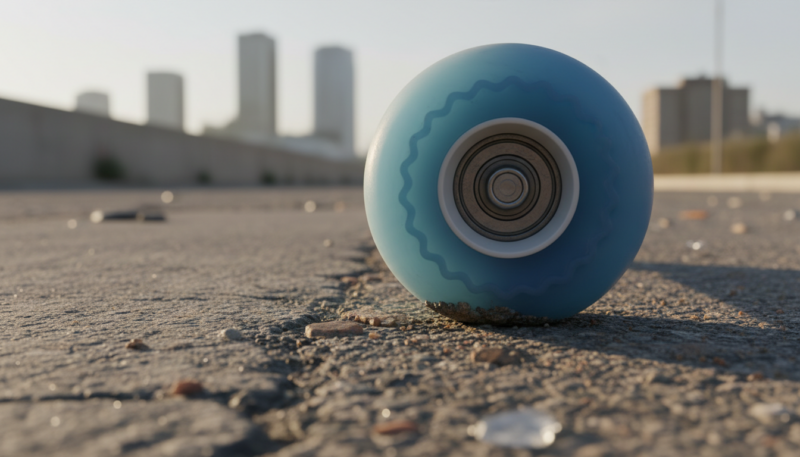
Many wheel manufacturers offer specialized profiles designed for urban riding, with subtle variations that can significantly impact performance on different types of city terrain. The combination of contact patch width and wheel profile creates a performance spectrum that allows skaters to fine-tune their setup for specific urban environments and riding styles.
Top Wheel Brands and Technologies for Rough Pavement
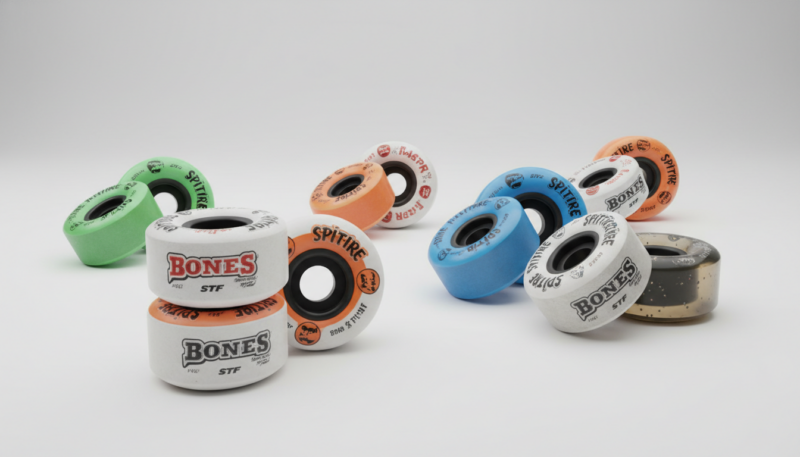
Top wheel brands have developed innovative technologies to help skaters conquer rough pavement. The quest for the perfect ride on urban terrain has driven manufacturers to create specialized wheel technologies.
Bones ATF and SPF Options
Bones is a leading brand in the skateboarding industry, offering several wheel technologies designed for different skating styles. Their ATF (All-Terrain Formula) wheels are particularly popular among urban skaters due to their ability to handle rough surfaces.
The ATF wheels feature a softer durometer (80a) that absorbs shock while maintaining good speed and performance characteristics. In contrast, Bones SPF (Skate Park Formula) wheels are designed for smooth surfaces but offer extreme durability and speed that some city skaters prefer.
Spitfire Formula Four and Other Premium Choices
Spitfire is another innovative brand that has made significant contributions to skateboard wheel technology. Their Formula Four wheels utilize a proprietary urethane formula that provides exceptional flat-spot resistance even in softer durometers.
Other premium brands like OJ Wheels, Powell-Peralta, and Ricta offer specialized options designed with urban terrain in mind. These brands have developed proprietary technologies to achieve the optimal balance of grip, roll speed, and durability.
The technology behind these premium wheel brands involves extensive testing and specialized molding processes. Many professional skaters who ride primarily in urban environments have signature wheel models that reflect their preferred specifications for navigating city terrain.
Conclusion: Making Your Final Wheel Selection
The ideal skateboard wheels can make all the difference for skaters navigating rough urban terrain. Selecting the right wheels involves balancing several factors, including personal skating style, the terrain most frequently encountered, and the skater’s skill level.
For those who primarily skate on rough urban terrain, softer wheels with larger diameters offer the smoothest ride and best shock absorption. However, intermediate to advanced skaters may prefer medium-soft wheels that balance shock absorption with the ability to perform technical street tricks.
It’s essential to consider wheel selection as part of the overall skateboard setup, as trucks, deck width, and bearing quality all interact with the wheels to determine performance on rough pavement. Experimentation is key, and many skaters maintain multiple wheel sets for different locations or skating objectives.
Wheel preferences are highly personal, so it’s crucial to try different options. Investing in quality wheels from reputable manufacturers typically yields better performance and longevity.
FAQ
What is the ideal wheel hardness for skating on rough city pavement?
Softer wheels, typically in the range of 78a-92a, are often preferred for rough city pavement as they provide more grip and absorb vibrations, making for a smoother ride.
How does wheel size affect performance on rough surfaces?
Larger diameter wheels can roll over rough surfaces more easily, while smaller wheels may get caught in cracks and irregularities. However, smaller wheels are more maneuverable and can be beneficial for technical street skating.
What is the difference between conical and classic wheel profiles?
Conical wheels, like Spitfire’s Formula Four Conical, have a unique shape that provides a larger contact patch and more grip, while classic wheels have a more traditional shape and are often used for technical skating.
Are harder wheels better for skate parks or street skating?
Harder wheels (95a-101a) are often preferred for skate parks as they provide more speed and durability on smooth surfaces. For street skating, softer wheels are often preferred for their grip and ability to absorb shock on rough surfaces.
How do I choose the right wheel brand and technology for rough pavement?
Look for brands like Spitfire and Bones, which offer a range of wheel technologies, such as Formula Four and ATF, designed for rough pavement and urban skating. Consider factors like wheel hardness, size, and profile when making your selection.
Can I use longboard wheels on my skateboard?
While it’s technically possible, longboard wheels are often larger and softer than traditional skateboard wheels, and may not be suitable for technical street skating or skate parks.
How do I know if my wheels are compatible with my skateboard trucks?
Check the clearance between the wheels and the trucks to ensure there’s enough space. Larger wheels may require wider trucks or more clearance to avoid rubbing or interference.
